- PXI & VXI Systems On Sale
- sku: 895010835776653
- LITEPOINT Z8551
Z8551 LITEPOINT Pxie Bit Signal Generator Repair
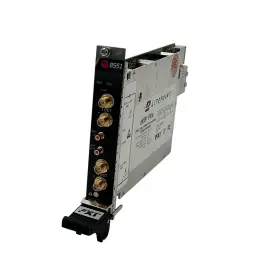
| Brand | LITEPOINT |
|---|---|
| Manufacturer Part Number | Z8551 |
| Part Type | BIT SIGNAL GENERATOR |
| Module Function | SIGNAL GENERATOR |
Review LITEPOINT Pxie 1gs/s Bit 512mb I/q Signal Generator Parts Repair
The LitePoint Z8551 is a high-performance, PXIe-based I/Q signal generator designed for testing and calibrating various communication systems. This versatile instrument is manufactured by LitePoint, a leading provider of advanced test solutions for wireless devices and networks.
Equipped with a 1 GS/s sampling rate, the Z8551 is capable of generating complex I/Q modulated signals with a maximum bandwidth of 300 MHz. It is built with a 16-bit resolution, ensuring superior signal fidelity and precision during testing. The I/Q signals can be configured to support various modulation schemes, including QPSK, 16QAM, and 64QAM, making it an ideal solution for testing advanced communication systems.
The Z8551 is housed in a PXIe form factor, allowing it to integrate seamlessly into a PXI system. This not only simplifies the integration process but also enables easy automation and remote control of the signal generator through standard PXI triggers and interfaces.
This LitePoint signal generator boasts a user-friendly interface, which can be accessed via the included WinBTS software. The software offers a wide range of features, including configurable test sequences, real-time spectrum analysis, and advanced analysis tools. This allows users to easily create, execute, and analyze tests, streamlining their workflows and increasing overall productivity.
The Z8551 also comes with 512 MB of onboard memory, which can be utilized for storing and replaying recorded waveforms. This is particularly useful for testing applications that require the use of long, pre-recorded test signals. Moreover, the signal generator supports both streaming and file-based data transfer, providing users with the flexibility to choose the method that best suits their testing requirements.
In terms of repair and maintenance, the Z8551 is designed with ease of service in mind. The instrument features a tool-less access door for easy access to internal components, and its modular design allows for quick replacement of individual modules should they require servicing. Additionally, LitePoint offers comprehensive repair and calibration services to ensure that any issues are addressed promptly and efficiently.
In summary, the LitePoint Z8551 is a powerful and versatile PXIe I/Q signal generator that caters to the testing and calibration needs of advanced communication systems. With its high sampling rate, 16-bit resolution, extensive modulation support, and user-friendly interface, this instrument provides users with the precision and flexibility they need to ensure the optimal performance of their systems. Furthermore, its robust design and easy-to-service features ensure a long operational life and minimal downtime for maintenance and repairs.
Pros and Cons of Buying a Litepoint Z8551 PXIe 1GS/s 16-bit 512MB I/Q Signal Generator for Repair Purposes
1. **Advanced Features**: The Litepoint Z8551 is a high-performance signal generator that supports I/Q modulation and offers a wide bandwidth of up to 1 GS/s. It also has a large memory capacity of 512 MB, which is ideal for generating complex waveforms.
2. **Compatibility**: This signal generator is designed to be used in a PXIe system, making it a great choice for those who use PXIe-based test setups. It can be easily integrated into existing test systems and can be controlled through software.
3. **Reliability**: Litepoint is a well-known and reputable manufacturer of test equipment. The Z8551 is built to high standards, ensuring reliable and accurate signal generation.
4. **Versatility**: This signal generator can generate various types of signals, including continuous wave (CW), modulated signals, and pulsed signals. It also supports multiple modulation types, including amplitude modulation (AM), frequency modulation (FM), phase modulation (PM), and quadrature amplitude modulation (QAM).
5. **High-Speed Processing**: With its fast processing capabilities, the Z8551 can generate complex signals in real-time, making it suitable for applications that require high-speed signal generation.
6. **Large Memory Capacity**: The large memory capacity of 512 MB allows users to store and recall complex waveforms, reducing the need to generate them in real-time.
7. **Expansibility**: The Z8551 has several built-in options for expansion, including additional memory, arbitrary waveform generation, and digital pattern generation.
**Cons:**1. **Price**: The Litepoint Z8551 is a high-end signal generator and comes with a corresponding price tag. It may not be affordable for those on a tight budget.
2. **Complexity**: Due to its advanced features, the Z8551 can be complex to use, especially for those who are new to signal generation or PXIe systems.
3. **Size and Weight**: As a PXIe module, the Z8551 requires a PXIe chassis and takes up a significant amount of space. It may not be suitable for those who have limited lab space or need a portable solution.
4. **Power Consumption**: The Z8551 consumes a considerable amount of power, which can result in higher operating costs.
**Conclusion:**The Litepoint Z8551 PXIe 1GS/s 16-bit 512MB I/Q Signal Generator is a powerful and versatile tool for repair applications that require high-speed signal generation and large memory capacity. Its advanced features, compatibility with PXIe systems, reliability, and expansibility make it a great choice for those who need a high-performance signal generator. However, its high price tag, complexity, size, weight, and power consumption may make it a less ideal choice for those on a tight budget or with limited lab space.
**Recommendation:**If you require a high-performance signal generator for repair applications and have the budget and lab space for it, the Litepoint Z8551 is a great choice. Its advanced features, compatibility with PXIe systems, reliability, and expansibility make it a powerful tool for generating complex signals and storing them for future use. However, if you have a limited budget or require a more portable solution, you may want to consider other options with fewer features but similar performance specifications.
Details:
It supports multi-standard wireless testing, optimized for high-throughput and parallel testing. It is used to test RF transmit/receive performance of wireless chip sets or modules in production environments. Purpose: the Litepoint Z8551 pxie is designed for wireless device testing, typically integrated into automated test systems Ats. Sold as is for parts repair only.
Model: Litepoint Z8551.
specifications vpxisyst:
- brand: Litepoint
- mpn: Z8551
- part type: Bit Signal Generator
- module function: Signal Generator
seller vpxisyst:
- rating: 99.2%
- city: crockett, california
- # reviews: 205
shipping vpxisyst:
- service: ups ground
- carrier: ups
- class: standard
- type: fixed
- transit: 4-9 days
general vpxisyst:
- category: Business & Industrial > Test, Measurement Inspection > Systems > Pxi Vxi Boards Modules
payments vpxisyst:
- wallet: paypal
- other
- credit card: discover
offer vpxisyst:
- in stock #: 5
- sold #: 19
- started: march 16, 2025
- options: ship-to-home
- availability: in stock
- best offers: true
- prices: $200.00–$639.20
- item condition:
- For parts or not working
- Used
returns vpxisyst:
- paid by: buyer
- policy: returns accepted
- method: money back
- time: 30 days
Similar Items:
- Litepoint Z5211 Pxie Arbitrary Waveform Generator 200mb s 14 Bit 128ms Part #: Litepoint Z5211 for sale...(January 9th, 2024)
- Litepoint Z8751 Pxie 1gs s 16 Bit 512mb 6ghz Vector Signal Generator Cal 4-21 1GS/S, 16 bit 512MB...(January 9th, 2024)
- Litepoint Z8451 Z 8451 Pxi I q Digitizer Parts Repair Type: high-performance RF i/q digitize. Sold as is for parts repair only. Model: Litepoint Z8451. Form factor: pxi...(March 17th, 2025)
- Litepoint Z8653 Pxie-dio 6ghz Wideband Vector Signal Analyzer Used Litepoint Z8653 pxie-Dior fully functional guarantee, the wide band vector signal analyzer Visa provides 1 GHz of instantaneous analysis band width for wide band modulated signals. Extremely low ecm floor of. The new Z8612 RF down converter module set serves as a 20 GHz spectrum analyzer ...(September 6th, 2025)