- PXI & VXI Systems On Sale
- sku: 1103264515384603
- ANALOGIC DBS901
DBS901 ANALOGIC Analogies Arbitrary Waveform Generator
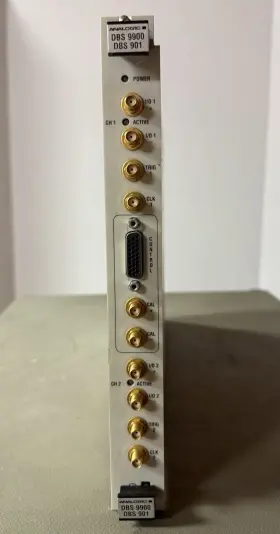
| Brand | ANALOGIC |
|---|---|
| Manufacturer Part Number | DBS901 |
| Part Type | GENERATOR |
Review ANALOGIC Analogies Arbitrary Waveform Generator
The Analogic Technologies DBS901 and DBS9900 Arbitrary Waveform Generators are versatile and high-performance instruments designed for a wide range of applications in research, development, and testing environments. These waveform generators deliver unparalleled accuracy and flexibility in generating complex analog waveforms.
The DBS901 is a compact, benchtop model, while the DBS9900 is a larger, rack-mountable version. Both models share similar features and capabilities but offer varying levels of channel count and bandwidth.
The heart of these waveform generators is their high-resolution 14-bit digital-to-analog converters (DACs), which provide excellent signal fidelity and linearity. With a sampling rate of up to 2GS/s, these instruments can generate waveforms with a frequency range from DC to over 1 GHz.
The DBS901 and DBS9900 support a wide range of waveform types, including sine, square, triangle, sawtooth, pulse, and arbitrary waveforms. Arbitrary waveform generation enables users to create complex waveforms by defining points in the time domain or by importing waveforms from a file. This feature is particularly useful in applications requiring precise control over waveform shape, such as signal conditioning, radio frequency (RF) testing, and communications systems development.
Both models offer high channel count configurations, with the DBS9900 supporting up to 16 channels, making it an ideal solution for applications requiring multiple independent waveform outputs. The instruments also feature advanced triggering and sequencing capabilities, allowing users to synchronize multiple waveform channels and generate complex waveform sequences.
The front panels of the DBS901 and DBS9900 include intuitive user interfaces, with large, high-resolution touchscreens that enable users to easily navigate complex waveform generation settings. The instruments also offer comprehensive software control through the Analogic WaveRunner software, which provides advanced waveform editing, analysis, and data logging features.
In summary, the Analogic Technologies DBS901 and DBS9900 Arbitrary Waveform Generators are powerful and flexible instruments designed for applications that require precise control over complex analog waveforms. With their high-resolution DACs, wide frequency range, and support for a variety of waveform types, these instruments offer unmatched versatility and accuracy for researchers, developers, and testing professionals.
Analogic DBS901 and DBS9900 Arbitrary Waveform Generators are advanced instruments used in various applications such as research, education, and industrial automation. Both generators offer unique features, but it's essential to consider their pros and cons before making a purchase decision.
Analogic DBS901: Pros:1. Wideband Analog Output: This generator can produce analog signals with a bandwidth of up to 1 GHz, making it suitable for high-frequency applications.
2. High Sample Rate: The DBS901 offers a maximum sample rate of 5 GS/s, enabling the generation of complex waveforms with high resolution.
3. Large Memory Capacity: It has a large memory capacity of up to 128 MB, allowing the storage of multiple waveforms for easy recall.
4. Triggering and Synchronization: The DBS901 provides various triggering and synchronization options, enabling precise control over waveform generation.
5. Multifunction Inputs: This generator includes multiple input channels for various functions, such as auxiliary inputs, reference inputs, and trigger inputs.
Cons:1. Complexity and Cost: The DBS901 is a high-end waveform generator, which comes with a higher price tag and a more complex user interface.
2. Size and Weight: Due to its advanced features, the DBS901 is larger and heavier than some other arbitrary waveform generators.
Analogic DBS9900: Pros:1. Multifunction Inputs: The DBS9900 offers a wide range of multifunction inputs, including auxiliary inputs, reference inputs, and trigger inputs.
2. High Bandwidth: This generator can produce signals with a bandwidth of up to 1.5 GHz, making it suitable for high-frequency applications.
3. Large Memory Capacity: The DBS9900 has a large memory capacity of up to 256 MB, allowing the storage of multiple waveforms.
4. High Resolution: It offers a high resolution of 14 bits, ensuring accurate waveform generation.
5. Triggering and Synchronization: This generator provides various triggering and synchronization options, ensuring precise control over waveform generation.
Cons:1. Complexity and Cost: Like the DBS901, the DBS9900 is a high-end waveform generator, which comes with a higher price tag and a more complex user interface.
2. Size and Weight: Both the DBS901 and DBS9900 are larger and heavier than some other arbitrary waveform generators due to their advanced features.
Conclusion:Both the Analogic DBS901 and DBS9900 are powerful arbitrary waveform generators with advanced features suitable for high-frequency applications. The primary difference between the two lies in their bandwidth capabilities, with the DBS9900 offering a slightly higher bandwidth.
If your application requires a higher bandwidth, the DBS9900 might be the better choice. However, if you need a lower bandwidth but still require the advanced features offered by these generators, the DBS901 could be a more cost-effective solution.
In summary, when deciding between the Analogic DBS901 and DBS9900, consider your specific application requirements and budget. Both generators offer advanced features and high performance but come at a higher cost and complexity compared to some other arbitrary waveform generators.
Details:
It is 100mhz, 14 bit, 1m sample memory, 20v p-p output. For sale is a Analogic DBS9900 universal module carrier. I no longer have a xvi controller and software which is why I m selling it as-is.
specifications vpxisyst:
- brand: Analogic
- mpn: Dbs901
- part type: Generator
seller vpxisyst:
- city: finksburg, maryland
- rating: 100.0%
- # reviews: 2189
returns vpxisyst:
- policy: no returns
shipping vpxisyst:
- carrier: usps, fedex
- transit: 5-12 days
- type: calculated
- service: usps ground advantage, fedex ground / fedex home delivery
- class: standard
general vpxisyst:
- category: Business & Industrial > Test, Measurement Inspection > Systems > Pxi Vxi Boards Modules
offer vpxisyst:
- prices: $300.67–$2900.00
- item condition:
- Used
- New – Open box
- best offers: true
- availability: in stock
- started: september 4, 2025
- options: ship-to-home
- sold #: 14
- in stock #: 3
payments vpxisyst:
- wallet: google-pay
- other
- credit card: discover